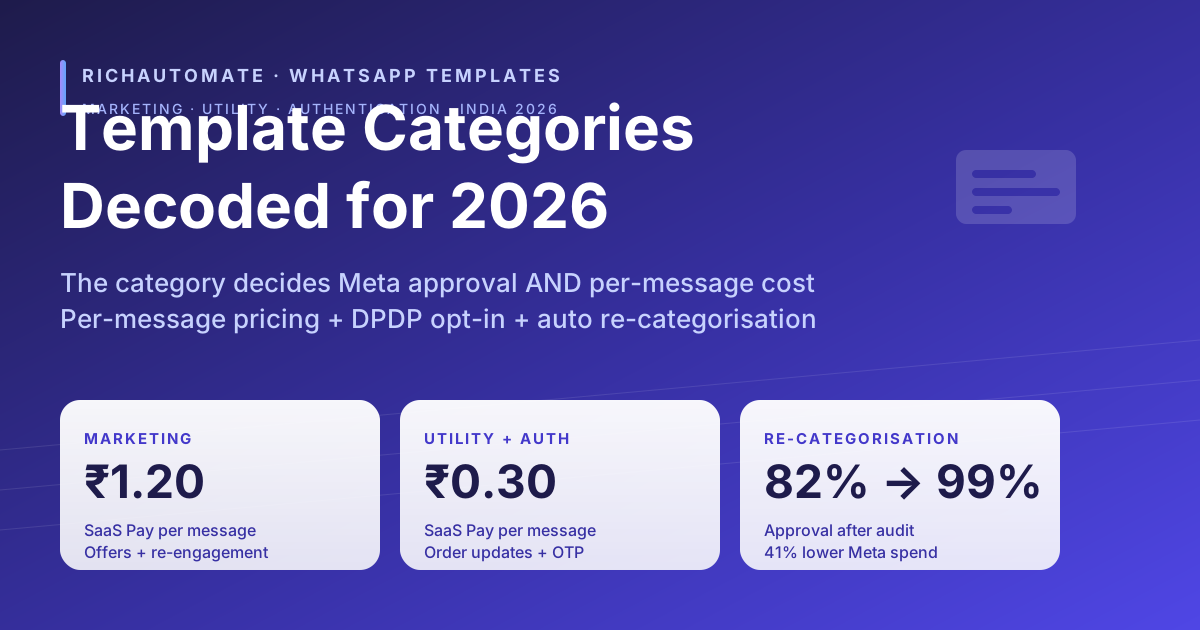
Under Meta's utility template guidelines, a WhatsApp template counts as Utility only if it is non-promotional and is either specific to something the user did or asked for (an order, a delivery, a payment, an account update) or essential to them (such as an outage or fraud alert); anything that mixes in an offer is Marketing. WhatsApp has three template categories, Marketing, Utility and Authentication, and the category decides both approval and price: in India Meta charges about ₹0.8631 per delivered marketing message and ₹0.115 per utility message. On RichAutomate, Client Pay adds ₹0.10 per message to Meta's rate (billed by Meta directly), while SaaS Pay is all-inclusive at ₹1.50 per marketing message and ₹0.50 per utility or authentication message. Meta bills per delivered template message, not per 24-hour conversation.
Disclosure: this guide is published by RichAutomate, a WhatsApp Business API platform. Category definitions, the utility tests and the re-categorisation rules were checked against Meta's template category guidelines for the WhatsApp Business Platform on 30 October 2026.
The Three WhatsApp Template Categories Explained
- Marketing. Anything promotional — offers, product launches, festival sales, abandoned-cart nudges, newsletters, re-engagement, win-back. If the message sells, upsells, or brings a lapsed customer back, Meta classifies it as Marketing. It is the highest-priced category and the one most likely to be rejected if it sneaks promotional language into a non-marketing template. Requires explicit opt-in under the DPDP Act 2023 and Meta's Business Messaging Policy.
- Utility. Transactional messages tied to a specific action or transaction the customer already initiated — order confirmations, shipping updates, delivery ETAs, payment receipts, appointment reminders, account alerts, ticket status. The trigger must be a real event (an order placed, a payment made, a booking confirmed). Utility cannot carry any promotional content; mixing in a discount code re-classifies it as Marketing.
- Authentication. One-time passcodes and login/verification codes only. These use Meta's fixed authentication template format (a code plus an optional copy-code or one-tap autofill button) and cannot include marketing copy, links, or extra context. Built for OTP delivery during signup, login, password reset, and transaction verification.
The category is decided by content, not by your intent. Meta's classifier reads the template body and reassigns the category if your content does not match the one you selected. A "Utility" template that says "Your order shipped — use code FEST20 for 20% off your next buy" will be re-categorised to Marketing (and billed at the higher rate) or rejected outright. Since 9 April 2025, a template submitted as Utility that Meta judges to be marketing is approved as Marketing from the start, and since July 2024 Meta has also run recurring checks on already-approved templates. Picking the right category up front is what keeps both your approval rate and your per-message cost predictable.
Meta's utility template guidelines: the official tests
This is the part most "meta utility template" searches are after. Meta's guidelines give Utility a two-part test, and a template has to pass both:
- Non-promotional. No promotional or persuasive intent at all: no offer, discount, upsell, "shop now" or cross-sell line, not even in a button.
- Specific or essential. It must be specific to, or requested by, the user (order confirmations, shipping updates, account alerts, opt-in confirmations, a follow-up on a call they made to your support team), or essential or critical to the user.
Meta lists the "essential" use cases by group: public safety (severe weather, crisis response), public service (health awareness and emergencies, voting registration, disbursements), public disruption (system outages, operational disruption), account or product protection (fraud awareness, product recalls, warranty alerts) and legal or regulatory compliance (identity compliance, privacy disclosures).
Meta also spells out what is not Utility:
- Mixed content, such as an order update with a promo line, is Marketing.
- Unclear content, such as a body that is only "{{1}}", is Marketing.
- A general or generic feedback survey will not be approved as Utility; it has to relate to a specific order or interaction.
- A one-time code dressed as a utility message belongs in Authentication. Meta notifies you and, on the first day of the following month, the utility version is rejected.
Re-categorisation, reviews and penalties
When Meta moves an approved Utility template to Marketing it normally gives one day's notice; for businesses that have been warned, the change is instant (since 16 April 2025). You can request a review up to 60 days after the category change; if the review is approved the original category is restored. Repeated mis-categorisation can lead to warnings, a rate limit on utility messages (minimum 7 days) and utility templates being moved to Marketing for 7 days, or 30 days for repeat violations.
You can test a draft against these rules before you submit with the free WhatsApp template approval checker, which flags promotional words in a Utility body as a category-downgrade risk.
WhatsApp Template Categories Compared (as of June 2026)
| Attribute | Marketing | Utility | Authentication |
|---|---|---|---|
| Purpose | Promotions, offers, re-engagement, newsletters | Transactional updates tied to a user action | One-time passcodes / verification codes |
| Trigger | Business-initiated outreach | A specific transaction or event (order, payment, booking) | Login / signup / reset / transaction verification |
| Opt-in required | Yes — explicit, DPDP-grade consent | Yes — opt-in still required under Meta policy | Yes — user requested the code |
| Promotional content allowed | Yes | No | No |
| Buttons / links | Up to quick-reply + URL + call buttons | Quick-reply + URL buttons (no promo) | Copy-code / one-tap autofill only |
| Meta cost in India (per delivered message) | Highest, about ₹0.8631 | About ₹0.115 | Meta's India authentication rate (see the current rate card) |
| RichAutomate SaaS Pay rate | ₹1.50 / message | ₹0.50 / message | ₹0.50 / message |
| RichAutomate Client Pay rate | ₹0.10 / message + Meta direct | ₹0.10 / message + Meta direct | ₹0.10 / message + Meta direct |
| Typical rejection cause | Misleading offer, missing opt-in, broken variable | Promotional language inside a utility body | Extra copy beyond the code + button |
How Meta Prices Each Category in India (as of June 2026)
WhatsApp moved from per-conversation pricing to per-message pricing for template messages. That means you are billed for each delivered Marketing, Utility, or Authentication template message — not for a 24-hour conversation window. The practical effect for Indian businesses:
The conversation window cost calculator is the quickest way to see what the window rules do to your monthly bill.
- Marketing is the most expensive per-message category and should be reserved for messages with a clear commercial payoff. Batch sends, segment tightly, and never send marketing without opt-in.
- Utility is materially cheaper, which is why moving order, payment, delivery, and appointment messages into properly-built Utility templates is the single biggest WhatsApp cost lever for most Indian D2C and services brands.
- Authentication uses Meta's India-specific OTP pricing and is the workhorse for fintech, BFSI, and any login-heavy app. Keep the body to the code plus an optional autofill button to stay compliant and approved.
- Service / free-form replies (your agent replying inside the 24-hour customer-service window, with no template): since 1 October 2026 the first 1,000 per number each month are free, and replies beyond that are charged at the utility rate of ₹0.115.
Worked example: what a wrong category costs. Take an Indian D2C brand sending 1,00,000 order and shipping updates a month. Built as clean Utility templates, Meta's charge is about ₹11,500 (1,00,000 × ₹0.115). If a promo line pushes the same messages into Marketing, the Meta charge becomes about ₹86,310 (1,00,000 × ₹0.8631), seven and a half times more for the same updates. On RichAutomate Client Pay, add ₹0.10 per message either way (₹10,000); on SaaS Pay the totals would be ₹50,000 as Utility or ₹1,50,000 as Marketing. These are list-rate calculations, not a customer case study.
Send these messages on WhatsApp, from your own number
We get your templates approved on the official WhatsApp API and set up your first broadcast with you. ₹0 platform fee, you pay only Meta's per-message rate.
Choosing the Right Category — A Decision Guide
- Is the message a login/verification code and nothing else? Use Authentication. Code + optional copy-code or one-tap autofill button only.
- Did the customer just do something (order, pay, book, raise a ticket) and you are updating them about that exact thing? Use Utility. No offers, no discount codes, no upsell.
- Are you initiating outreach to sell, promote, re-engage, or announce? Use Marketing — and confirm you hold explicit opt-in.
- Does the body mix a transactional update with a promo line? Split it. Send the Utility update, then a separate Marketing message — combining them gets the whole thing priced and reviewed as Marketing.
- Unsure? Default to the stricter category. Meta will upgrade Utility-to-Marketing on its own if content warrants, but it will not silently downgrade — so building lean Utility templates protects your cost.
Need ready-to-copy Utility examples? Start with these booking confirmation message templates for appointments and reservations, service reminder message templates for due-date and maintenance nudges, and apology message templates for customers for when an order or service goes wrong.
Common Template-Category Mistakes Indian Businesses Make
- "Order shipped + here's 10% off" in one Utility template. The discount line forces Marketing classification and the higher rate. Keep the two messages separate.
- OTP templates padded with branding or links. Authentication templates must be code-plus-button. Extra copy triggers rejection.
- Sending Marketing without DPDP-grade opt-in. The DPDP Act 2023 plus Meta's Business Messaging Policy require explicit, purpose-bound consent before any marketing template — missing consent risks quality-rating damage and number bans.
- Treating category as a billing-only choice. Category drives approval, deliverability, quality rating, and cost simultaneously. Get it right at template-creation time, not after rejection.
- Ignoring per-message pricing. Since Meta bills per delivered template message (per-message pricing replaced conversation pricing on 1 July 2025), high-frequency Marketing blasts compound fast — segment and earn the send.
- Sending generic feedback surveys as Utility. Meta says a general request for feedback will not be approved as Utility. Tie the survey to a specific order or support interaction, or submit it as Marketing.
Three edge cases come up often once categories are clear: a limited-time offer template with a countdown is always marketing, the Business App's unanswered message limit does not apply to API templates, and the WhatsApp Business Solution Terms decide who carries liability when a template is misclassified.
Authority References
- Meta WhatsApp Business Platform — Template Categories & Guidelines: official definitions for Marketing, Utility, and Authentication, plus automatic category reassignment rules. developers.facebook.com — Message Templates
- Meta — WhatsApp Business Pricing (per-message): current category-based per-message pricing model and India rates. developers.facebook.com — Pricing
- Meta Business Help — Template message categorisation: how content determines category and what causes reassignment. business.whatsapp.com — Business Platform
- DPDP Act 2023 (MeitY): consent and purpose-limitation requirements that govern Marketing opt-in for WhatsApp in India. meity.gov.in — Data Protection Framework
Template categories are approved by Meta, not by any telecom registry — so you do not need DLT registration for the WhatsApp API.
Ship the right template category on RichAutomate.
Build Marketing, Utility, and Authentication templates with an approval check and an optional AI utility advisor that suggests a Utility rewrite of a promotional draft before you submit to Meta, so you stop paying Marketing rates for transactional messages. ₹0 setup and no mandatory monthly fee (optional plans from ₹499 a month). Client Pay ₹0.10/message plus Meta direct, or SaaS Pay ₹1.50 marketing + ₹0.50 utility/authentication, all-inclusive. See pricing. Start free with a 14-day trial and 100 message credits. WhatsApp +91 81603 11319 or book a 30-minute walkthrough.
New to WhatsApp automation? Start with our step-by-step guide to getting the WhatsApp Business API for the full picture, then come back to apply it here.
For ready-to-adapt Marketing-category copy, browse our promotional WhatsApp message examples for India.
For a worked Utility example, see these WhatsApp payment confirmation templates and how an added offer flips them to Marketing.
For worked examples of an intro written as a Marketing template, and one written as Utility onboarding, see these introduction message templates for WhatsApp.
If fixes like this take days with your current provider, compare a Gupshup alternative and a Wati alternative, and estimate your monthly bill with the WhatsApp API cost calculator.
Related reading
- WhatsApp template rejection fixes — what to do when Meta bounces your marketing or utility template
- WhatsApp Business API cost in India 2026 — the per-category rates behind marketing vs utility vs authentication
- state of WhatsApp API pricing in India 2026 — research data on how category pricing shifted this year
Sending login or verification codes? Compare channels in WhatsApp OTP vs SMS OTP.
For a festive example of marketing vs utility categories in practice, see these Chhath Puja WhatsApp message templates.