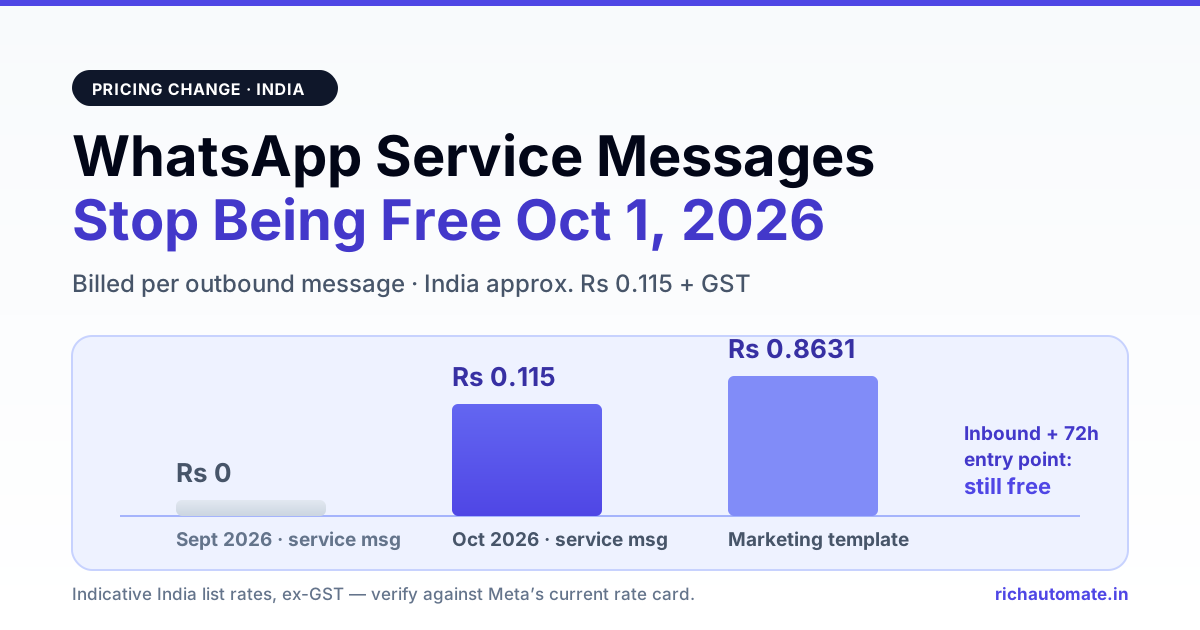
From 1 October 2026, Meta restores per-message billing on service messages — the free-form replies your agents send inside an open 24-hour customer-service window — at rates broadly matching Utility and Authentication, which in India sits at roughly ₹0.115 per message before GST (verify against Meta's current India rate card; volume tiers discount it). For two years those replies were free, so most Indian senders have never carried a line item for support conversation volume. From October the support inbox becomes a metered cost centre: a 40-message back-and-forth that cost ₹0 in September costs roughly ₹4.60 plus GST in October.
This is a reaction guide for Indian businesses running the WhatsApp Business API: what changes on 1 October, what the separate token-based Meta Business Agent meter (live since 1 August 2026) adds on top, cost modelling for three sender archetypes, what stays free, and a runbook to cut the bill before the meter starts. Every Meta specific below is flagged verify-exact — rate cards move, and this article is written to be accurate on mechanics rather than to pretend it quotes a live price feed.
What Actually Changes on 1 October 2026
The change is narrow but consequential. Meta is not touching template pricing. It is removing the zero-rating on non-template messages sent inside an open service window.
| Message type | Until 30 Sep 2026 | From 1 Oct 2026 | India rate (indicative) |
|---|---|---|---|
| Marketing template | Charged | Charged (unchanged) | ~₹0.8631 |
| Utility template | Charged | Charged (unchanged) | ~₹0.115 |
| Authentication template | Charged | Charged (unchanged) | ~₹0.115 |
| Service message (free-form, inside 24h window) | Free | Charged | ~₹0.115 |
| Free Entry Point (CTWA / Page CTA) 72h window | Free | Free (unchanged) | ₹0 |
| Inbound messages from customers | Free | Free (unchanged) | ₹0 |
Rates indicative, ex-GST, India list pricing. Add 18% GST. High-volume senders negotiate below list. Verify the exact figure on Meta's published India rate card before you budget against it.
Two details decide whether this is a rounding error or a real hit for your business:
- It bills per outbound message, not per conversation. A single support thread in which your agent sends 14 replies is 14 billable events, not one. Verbose agents are now expensive agents.
- Any non-template outbound outside Meta Business Agent is reclassified as a service message. If you route free-form sends through the API today — order updates typed by a human, escalation notes, quick clarifications — they land in this bucket from 1 October.
The Second Meter: Token-Based Meta Business Agent Pricing
Separately, since 1 August 2026 Meta Business Agent — Meta's hosted AI assistant for qualifying leads, answering questions and booking appointments — moved to consumption billing at roughly $2 per million tokens globally. A typical customer interaction consumes 20,000–25,000 tokens, landing around 4–5 US cents per exchange (roughly ₹3.50–₹4.50). Simple confirmations burn fewer tokens; multi-turn troubleshooting burns considerably more.
That charge bundles AI processing and message delivery into a single line. If you already run your own model stack the economics differ — see our BYOK LLM cost control guide for WhatsApp AI agents, which covers the bring-your-own-key pattern where you pay your model provider directly and keep per-token spend visible and cappable.
Cost Modelling: Three Indian Sender Archetypes
The numbers below are illustrative models, not audited client data. They exist to show which shape of business absorbs this change and by how much. Substitute your own send mix before you take any of it to finance.
| Archetype | Monthly service messages | Sept 2026 cost | Oct 2026 cost (@₹0.115) | Delta incl. GST |
|---|---|---|---|---|
| D2C brand, 3k orders/mo, mostly template-driven | ~6,000 | ₹0 | ₹690 | +₹814 |
| Edtech, human counsellor-led admissions | ~48,000 | ₹0 | ₹5,520 | +₹6,514 |
| Logistics / field-service support desk | ~120,000 | ₹0 | ₹13,800 | +₹16,284 |
The pattern is clear: template-heavy senders barely notice; conversation-heavy senders absorb a genuinely new five-figure monthly line. If your model is cheap acquisition plus heavy human handholding, October reprices your support function.
Why Support-Heavy Senders Get Hit Hardest
- Human agents are chatty by design. Good support reads as several short messages rather than one wall of text. That habit was free and is now billed per bubble.
- Escalations multiply sends. A tier-1 to tier-2 handoff typically doubles the outbound count on the same issue without changing the outcome for the customer.
- Nobody instrumented it. Because service messages cost nothing, most Indian BSP dashboards do not surface outbound-per-resolution as a first-class metric. You are about to be billed against a number you have never measured.
The Seven-Step Cost-Control Runbook
Do these before 1 October. Most are configuration, not engineering.
Get a 1-minute BSP audit on WhatsApp
Drop your WhatsApp number — we line-item your current invoice against Meta India rates in under 60 seconds. India-hosted, DPDP-compliant.
- Baseline outbound-per-resolution now. Pull 30 days of outbound non-template sends per closed conversation. That single number is your October exposure multiplier. If your BSP cannot export it, pull it from your own message log.
- Collapse multi-bubble replies. An agent macro that sends one structured message instead of four cuts 75% of that thread's cost with no change to resolution quality. This is the highest-ROI change available and it ships in a day.
- Push deterministic updates back into Utility templates. Order shipped, appointment confirmed, payment received — if it is predictable it belongs in a template at the same ~₹0.115, and templates work outside the window too, so you stop paying twice when a window lapses and has to be reopened.
- Harvest Free Entry Point windows properly. Click-to-WhatsApp ads and Page CTA buttons still open a 72-hour fully free window, and that has not changed. Our guide to mastering Meta's 72-hour free window covers routing acquisition traffic so more conversations start inside it.
- Re-tune your 24-hour window strategy. The economics of when to reply, when to batch and when to let a window close have all inverted. Work through 24-hour service window cost optimisation for India and WhatsApp 24-hour window and session economics with the new per-message assumption plugged in.
- Deflect with self-serve before a human touches the thread. An FAQ flow, an order-status lookup or a scheduling flow resolves the query in one or two sends instead of twelve. This is where automation stops being a nice-to-have and starts paying for itself inside the same month.
- Set a monthly spend alert. A wallet threshold, a billing alarm, an internal report — whatever your platform supports. The failure mode here is not a huge bill; it is a huge bill nobody noticed until the quarter closed.
What Stays Free After 1 October
- All inbound messages from customers. You are never charged to receive.
- Free Entry Point conversations — the 72-hour window opened by Click-to-WhatsApp ads and Facebook Page call-to-action buttons, where any message type is free.
- Undelivered templates. Billing is on delivery, not on send attempt.
That Free Entry Point carve-out is the most under-used lever in the Indian market. A business that shifts a meaningful share of first contact into CTWA is not only buying cheaper leads, it is buying 72 hours of zero-rated conversation on each one.
India-Specific Notes
Local currency billing. Eligible Indian accounts now bill in INR rather than USD. That removes FX drift from month-to-month comparisons, and also removes the accidental discount some senders picked up on a weak-dollar month.
GST. Add 18% on top of every figure above. The ₹13,800 in the logistics model lands at ₹16,284.
Consent and DLT are unchanged by this. Pricing moved; the compliance floor did not. Opt-in capture under the DPDP framework still applies exactly as before — see the DPDP Act WhatsApp business compliance checklist. Do not let a cost-optimisation sprint quietly loosen your consent records.
Context for the change. India is WhatsApp's largest market at roughly 850 million users and contributes over $1 billion a year to Meta's business-messaging revenue. Indian senders are not a rounding error in this decision; they are the reason for it.
Thirty-Day Readiness Checklist
| Week | Action | Owner | Done when |
|---|---|---|---|
| Week 1 | Export 30 days of outbound non-template sends; compute sends-per-resolution | Ops / BSP admin | One number, plus a per-team breakdown |
| Week 1 | Model October cost = monthly service sends × rate × 1.18 | Finance | Figure sits in the Q3 forecast |
| Week 2 | Rewrite the top 10 agent macros into single structured messages | Support lead | Macros live, agents briefed |
| Week 2 | Move predictable notifications from free-form to Utility templates | Product / engineering | Templates approved by Meta |
| Week 3 | Route acquisition spend toward CTWA to harvest 72h free windows | Growth | CTWA share of first contact measured |
| Week 3 | Ship or tune a self-serve flow for the top 3 query types | Product | Deflection rate baselined |
| Week 4 | Set wallet threshold and monthly spend alert | Finance / ops | Alert fires on a test threshold |
Where RichAutomate Fits
RichAutomate charges a ₹0 platform fee. On Client Pay you connect your own Meta billing and pay RichAutomate ₹0.10 per message; on SaaS Pay it is ₹1.20 for marketing and ₹0.30 for utility and authentication, inclusive. A 14-day trial with 100 credits is available. The part that matters for October is that the platform surfaces outbound counts per conversation, so sends-per-resolution — the metric this change bills you against — is visible rather than inferred, and flows let you deflect the repetitive query types before an agent is billed for answering them by hand.
If you are still comparing providers on headline rate alone, the full cost table in WhatsApp Business API pricing in India 2026 and the mechanics in Meta's per-message pricing change are the two pieces to read alongside this one. After 1 October, a provider's ability to reduce your message count matters more than a two-paisa difference in their markup.
The Short Version
Service messages stop being free on 1 October 2026, at roughly ₹0.115 each in India plus GST, billed per outbound message rather than per conversation. Meta Business Agent has metered tokens separately since 1 August at about $2 per million. Inbound stays free and the 72-hour Free Entry Point window stays fully free. The businesses that will not feel this are the ones that measure sends-per-resolution in September and cut it before October. Everyone else finds out from an invoice.
Related reading
- Meta WhatsApp Per-Message Pricing India 2026: What Changed & How to Migrate
- WhatsApp 24-Hour Service Window Cost Optimization (India 2026)
- WhatsApp 24-Hour Window & Session Economics 2026
- The 72-Hour Free Window: Mastering Meta's 2026 Strategy
- WhatsApp Business API Pricing India 2026: Full Cost Table
- BYOK LLM Cost Control for WhatsApp AI Agents India 2026